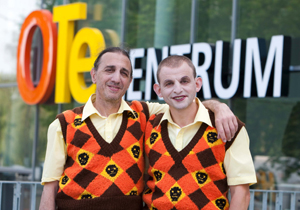
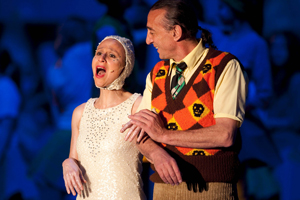
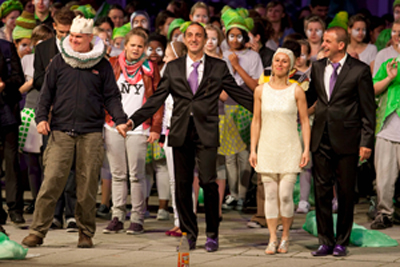
thank you to the photografer Jörg Sarbach
Karsten Gundermann, Composer Alexander Shelley, Conductor Julia Haebler, Director Dominique Horwitz, Faust Speaker Jean Laurent Sasportes, Faust Dancer Etta Scollo, Helena Mateng Pollkläsener, Fool and 500 participating students from the Bremen East Comprehensive School and sponsors from Bremen's Tenever neighborhood
»Faust II in a school performance - that is naturally a daring project. But the enthusiasm and tremendous commitment of all the participants convinced me immediately. I am eagerly looking forward to the collaboration with the students and The Deutsche Kammerphilharmonie Bremen. And I am delighted to be part of this fantastic team.« (Dominique Horwitz) ------- Faust II - Spoken opera for a neighborhood, with over 500 participants
The Deutsche Kammerphilharmonie Bremen is entering the final phase of its project from the Future Lab. For almost a year the musicians of the world-class orchestra have devoted themselves intensively to this special version of Goethe's classic work with students of many different nationalities and teachers from the Gesamtschule Bremen-Ost. Together with various local partners, ranging from the dike association and the pastor to the barracks, police, fire department, and many other institutions and people from Osterholz-Tenever, they will present a gigantic open-air event on two summer evenings, 11 and 12 June. There are over 500 participants - the entire neighborhood is involved. The orchestra received the German Founders Award in the category Special Award 2008 for its Future Lab. The Deutsche Kammerphilharmonie Bremen at theGesamtschule Bremen-Ost (Bremen East Comprehensive School)
Since April 2007, the focal point of The Deutsche Kammerphilharmonie Bremen's work has been at the Gesamtschule Bremen-Ost (Bremen East Comprehensive School), where it collaborates closely with pupils and teachers on projects which are intended to significantly help improve conditions in this disadvantaged area of the city.
Society is in danger of being polarized into rich and poor. In order to counteract this tendency, people from different social strata, cultures, and religions can meet in the ›Future Lab.‹
Music is a catalyst for such encounters. For the first time, the Future Lab provides an opportunity to make a lasting impact with these projects. The social megatrends identified by futurologist Matthias Horx – such as individualization, education, and new work – can be explored here in a laboratory situation.
Crossing boundaries, forming relationships, and creating something new from them. For the musicians of The Deutsche Kammerphilharmonie Bremen, this equation has invariably balanced during their careers. The orchestra was always convinced that it had found the optimal new rehearsal space at the Gesamtschule Bremen-Ost (Bremen East Comprehensive School). Even skeptics were silenced. The venture of having a world-class orchestra and a school under one roof in a disadvantaged area has borne fruit. The Deutsche Kammerphilharmonie Bremen has settled into its ›Future Lab.‹
Close contact between musicians and school children is welcome and strongly encouraged. The fact that this collaboration is producing good results is shown by the muchacclaimed project ›Melody of Life.‹ Both the pupils and ensemble members are full of enthusiasm when they make the school resound with music.
---------------------------------------- tothetop |